The 80/20 Rule for Bloggers: How to Work Less and Earn More

If you’ve ever felt like you’re doing all the things in your blog business — writing posts, designing pins, posting on social media, checking analytics, and still wondering why you’re not seeing results, you’re not alone.
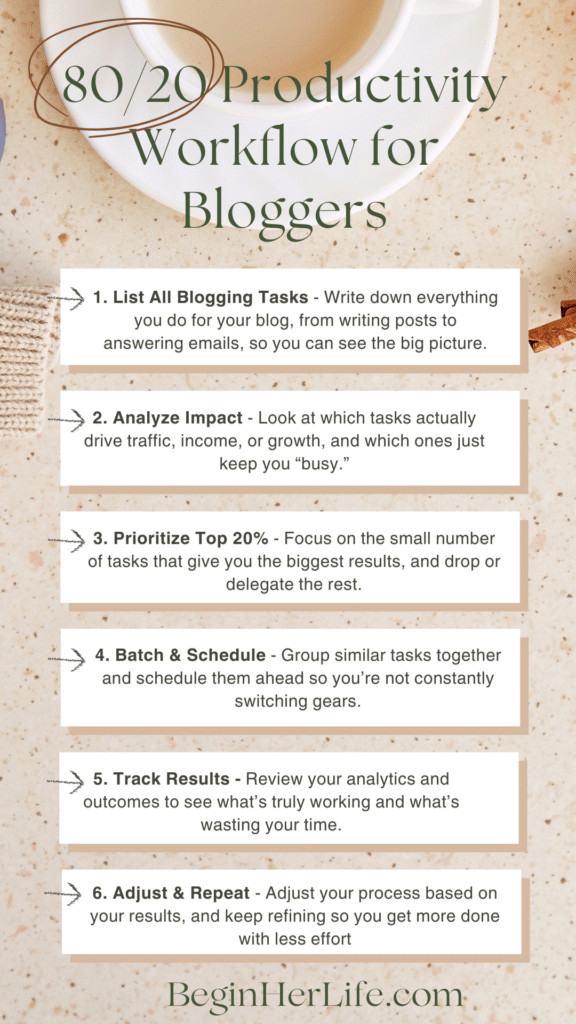
It can be incredibly frustrating when you’re doing everything you’re supposed to do without seeing any results. The truth? Most of what you’re doing isn’t moving the needle. The key to seeing the results you want isn’t simply to do more, but to do more of the right things. By focusing on the few things that have the greatest impact, you work more effectively and avoid burning yourself out.
This is where the 80/20 Rule (also called the Pareto Principle) comes in, and it’s about to become your new best friend.
What is the 80/20 Rule?
The idea is simple:
- 80% of your results come from 20% of your efforts.
- The rest? It’s busywork.
In the book The 4-Hour Workweek, Tim Ferriss talks about identifying the few things that make the biggest difference and either automating, delegating, or deleting everything else. The core of this principle is to work smarter, not harder. By applying this principle, not only can you see better results in your business (more views, better conversions, etc.), but you can free up your time!
In the context of blogging, this means a small portion of your posts, promotions, or even marketing channels could be responsible for most of your traffic, engagement, and income. For example, you might find that one well-written post drives the majority of your site visitors, or that one platform (say, Pinterest) brings you more clicks than all your other social media combined.
If this is the case, you could apply the 80/20 rule by deciding to create more content that branches off that one well-written post, or edit old posts to bring them up to the same quality. As for marketing, if your Pinterest account is driving most of your traffic, then you could cut out Instagram, TikTok, and Facebook if they’re not pulling their weight and focus solely on Pinterest. Instead of trying to force other platforms to work, take a step back and fully embrace what’s already working.
Why the 80/20 Rule is a Game-Changer for Bloggers
When you’re building a blog, your time is limited. You’re likely balancing work, life, and learning how to grow an online business. This can be a lot to juggle at once, and you have the most control over how you run your blog. So, why not make it as easy as possible for yourself to succeed?
If you try to do everything, you’ll end up burned out with very little to show for it, or you’ll end up quitting altogether.
But it doesn’t have to be that way if you focus on the right 20%; you can grow faster and free up time to enjoy life.
Finding Your 20%: What Actually Moves the Needle in Blogging
Step 1: Spot Your High-Impact 20%
For most new bloggers, the highest-impact activities are going to be:
- Publishing SEO-friendly blog posts consistently — these are your long-term traffic machines.
- Driving traffic from Pinterest — fast results + your ideal audience is already there.
- Building your email list — it’s the only audience you truly own.
- Selling products or recommending affiliates — turning readers into income.
Everything else, like tweaking your logo for the 14th time or joining every single Facebook group, might feel productive, but it won’t bring the same return. That’s not to say you can’t change your logo or join Facebook groups, but time spent on these things should be kept to a minimum.
If you’ve been blogging for a while already and have a few different social media platforms, have steady blog traffic, but are still feeling stuck, here are a few things you can do to identify your 20% to focus on:
- Dive into your analytics – Tools like Google Analytics can show you which posts bring the most traffic. Look for patterns: are they listicles, how-to guides, or personal stories?
- Check your engagement metrics – Which posts get the most comments, shares, or time spent reading? Those are your connection-builders.
- Look at your marketing channels – As mentioned above, if one platform brings you most of your traffic, focus more energy there instead of spreading yourself thin.
Once you spot your top performers, you can build more content just like it, knowing you’re playing to your strengths.
Examples of 20% vs. 80% Tasks in Blogging
| High-Impact (20%) | Low-Impact (80%) |
|---|---|
| Writing SEO blog posts | Endless theme tweaks |
| Creating Pinterest pin templates | Spending 3 hours on Instagram reels |
| Emailing your list weekly | Over-researching for “perfect” ideas |
| Launching a digital product | Joining random webinars without action |

How to Apply the 80/20 Rule to Your Blog
Step 2: Create Smarter, Not More
The 80/20 mindset is all about high-impact work. Instead of churning out endless posts, focus on the topics and formats you know your audience loves.
A few ideas:
- Repurpose your best stuff – Turn a blog post into a video, a podcast, an infographic, or a series of social posts.
- Use templates and checklists – They keep your content consistent and save you hours of formatting and editing.
- Batch your work – Dedicate one day to writing, another to editing, another to promotion. It cuts down on mental “switching costs” and keeps you in the zone.
By creating content that you already know your audience loves, you skip the guessing game and get faster results.
Step 3: Manage Your Time Like a Pro
Time is a blogger’s most precious resource. The 80/20 rule means you spend it where it matters most. Try:
- Batching tasks – Write three posts in one sitting instead of starting and stopping all week.
- Setting specific goals – Instead of “I should post more,” commit to “Two quality posts per week.”
- Using productivity tools – Apps like Trello or Asana help keep you on track, while tools like RescueTime can keep you from accidentally scrolling TikTok for an hour.
By eliminating distractions and locking in, you’ll be able to do more in less time. Taking the time to be intentional with what you’re working on will also improve the quality of your work!
Step 4: Be Picky with Social Media
Not all platforms are created equal. Instead of trying to be everywhere, double down on the one or two platforms that actually bring results.
- Find out where your audience hangs out – If they’re on Pinterest and Instagram, put most of your energy there.
- Focus on quality interactions – Reply to comments, ask questions, and start conversations. That’s how you build loyalty.
- Plan ahead – A simple content calendar keeps you consistent without taking over your life.
Remember, you don’t have to reply to every single comment to keep your audience happy. Instead, set aside specific days each week to respond, and give yourself a time limit so it doesn’t take over your day. It’s also okay to let older conversations go; you probably don’t need to reply to a comment on a post or pin from two years ago. For your blog, you can even turn off comments after a certain amount of time to keep things manageable.
Step 5: Automate & Outsource
Your time is better spent creating great content and connecting with your audience—not drowning in repetitive tasks.
- Automation – Use tools like Buffer, Hootsuite, or Tailwind to schedule social posts, and email tools like ConvertKit to send newsletters automatically.
- Outsourcing – If budget allows, hire a virtual assistant for editing, graphics, or social media scheduling so you can focus on your creative zone.
One of the best ways to free up both your time and your mind is to combine batching with automation. Spend a little time now creating several blog posts or social media updates, then schedule them to go live weeks in advance. That way, you can use those free weeks to connect with your readers, brainstorm new ideas, and keep building content so you’re always a step ahead.
Step 6: Keep Measuring & Adjusting

” What gets measured, gets managed ” -Peter Drucker
Your 20% today might not be your 20% in six months. Keep checking your analytics, testing new strategies, and letting go of what’s not working. At a minimum, I would suggest evaluating your strategy every six months to make sure you’re still working as effectively as you can be.
Things to focus on:
- Track your KPIs – Page views, engagement, and conversions show you what’s paying off.
- Collect feedback – Comments, DMs, and surveys can reveal what your audience wants more of.
- Drop what’s not working – Don’t be afraid to ditch strategies that aren’t delivering results.
The more you measure, the more you can fine-tune your process and the faster you can grow.
Step 7: Build a Loyal Community
An engaged audience is pure gold. When readers feel connected to you, they’re more likely to share your posts, buy your products, and stick around for the long haul.
To build a loyal audience:
- Respond to comments & emails – Show readers you see and value them.
- Ask for input – Let them help shape your content.
- Host live sessions or Q&As – Connecting in real time helps build trust and loyalty.
When you focus on the relationships that matter most, you’ll see that the 80/20 rule applies here too: a small group of dedicated followers can drive most of your success.
Final Thoughts: The 80/20 Blogging Mindset
The 80/20 rule isn’t about being lazy; it’s about being strategic. By identifying what’s actually working, putting more energy into it, and letting go of the rest, you’ll:
- Improve your connection with readers
- Grow faster
- Work fewer hours
- Avoid burnout
- Actually enjoy blogging again
At the end of the day, the 80/20 rule is about doing less of the stuff that doesn’t matter and more of the stuff that moves the needle.
Your blog doesn’t need more content—it needs the right content. Your day doesn’t need to be busier; it needs to be better spent.
Work smarter, not harder, and watch your results multiply!
Your Next Step
This week, challenge yourself to cut just one low-impact blogging task and replace it with something from your 20% list.
Let me know in the comments what’s one part of your blogging routine that brings you the biggest results, and what’s one thing you’re ready to stop doing?





Leave a Reply